

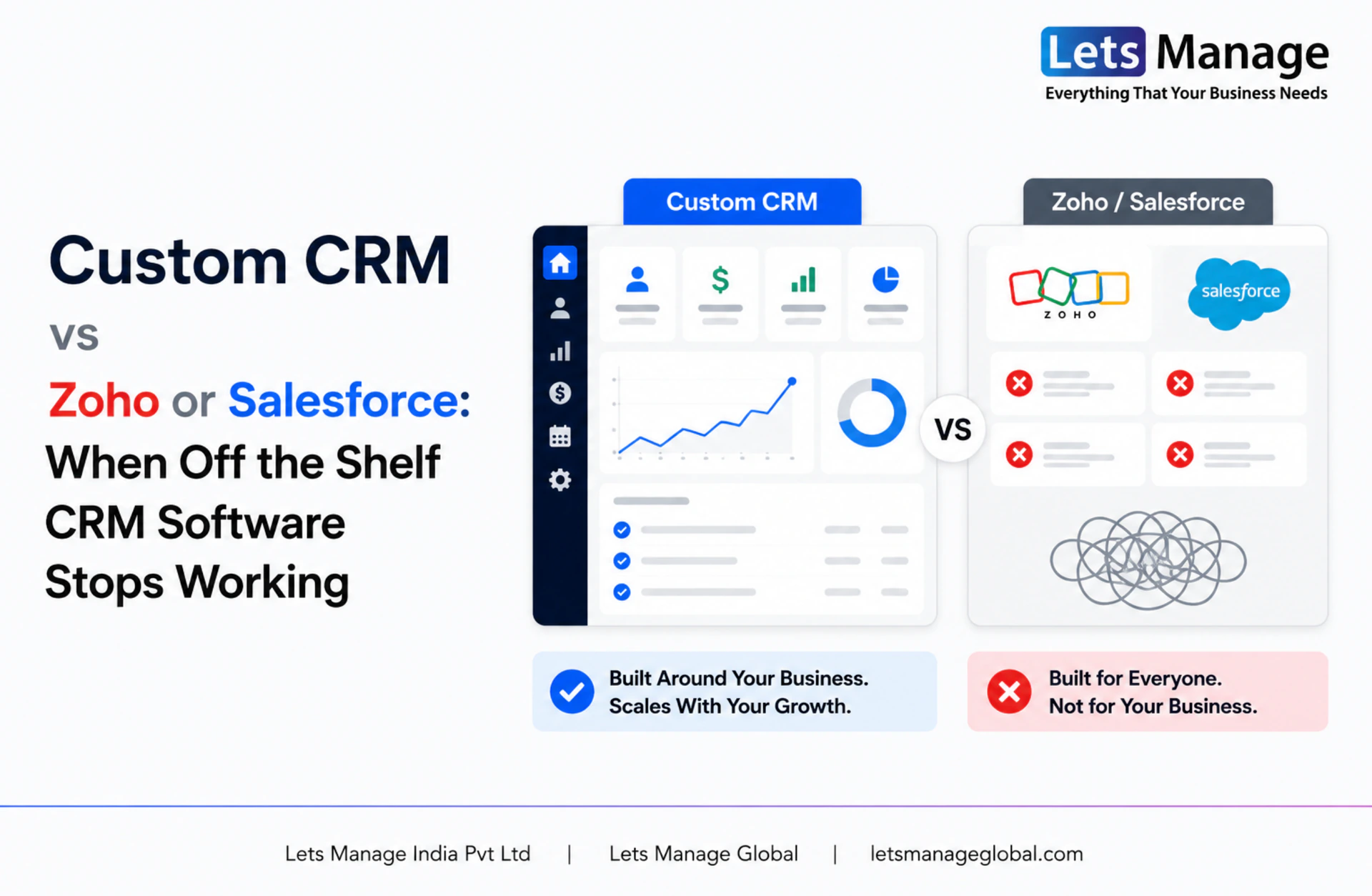
Quick answer: Off the shelf CRM platforms are the right starting point for most small teams because they are fast to deploy and low cost. A custom CRM becomes the better investment once a business has a unique sales process, needs deep integration with existing systems (ERP, HRM, industry specific tools), or is paying for licensed features it never uses.
The honest case for off the shelf CRM first
Platforms like Zoho and Salesforce exist because most sales processes share common shapes (lead, qualify, quote, close). For a business under 15 to 20 users with a fairly standard process, these platforms deliver good value quickly, and building custom software at that stage is often overkill.
The signs a business has outgrown off the shelf CRM
- Paying for a large tier of licenses just to unlock the two or three features actually used
- Constantly working around the platform's fixed workflow instead of with it
- Needing deep, real time integration with ERP, HRM, or a proprietary quoting or inventory system that off the shelf connectors do not support cleanly
- Facing rising per seat licensing costs every year as the team grows, with no ownership of the underlying system
What a custom CRM changes economically
A custom CRM has a higher upfront build cost but no recurring per seat licensing fee, no forced upgrades, and no feature paywalls. For a business scaling its sales team significantly over the next 3 to 5 years, the total cost of ownership frequently favors a custom build once the license bill from an off the shelf platform is projected forward.
The migration reality
Businesses rarely rebuild from scratch. Most transitions to a custom CRM export and migrate historical lead and deal data from the existing platform, so no history is lost, and the team continues from where they left off inside a system built specifically around their process.
FAQ
Is a custom CRM more secure than Zoho or Salesforce?
Both approaches can be secure. The real difference is control: a custom CRM's data lives on infrastructure the business fully owns and configures, while an off the shelf platform's security depends on the vendor's shared infrastructure and settings.
How long does it take to move from Zoho or Salesforce to a custom CRM?
Typically 6 to 10 weeks including data migration, team training, and a short parallel run period to confirm nothing was lost in the switch.
Do I lose integrations I already use, like email or calendar sync?
No, standard integrations like email, calendar, and WhatsApp are rebuilt into the custom CRM as part of the project scope, since these are common requirements, not platform exclusive features.