

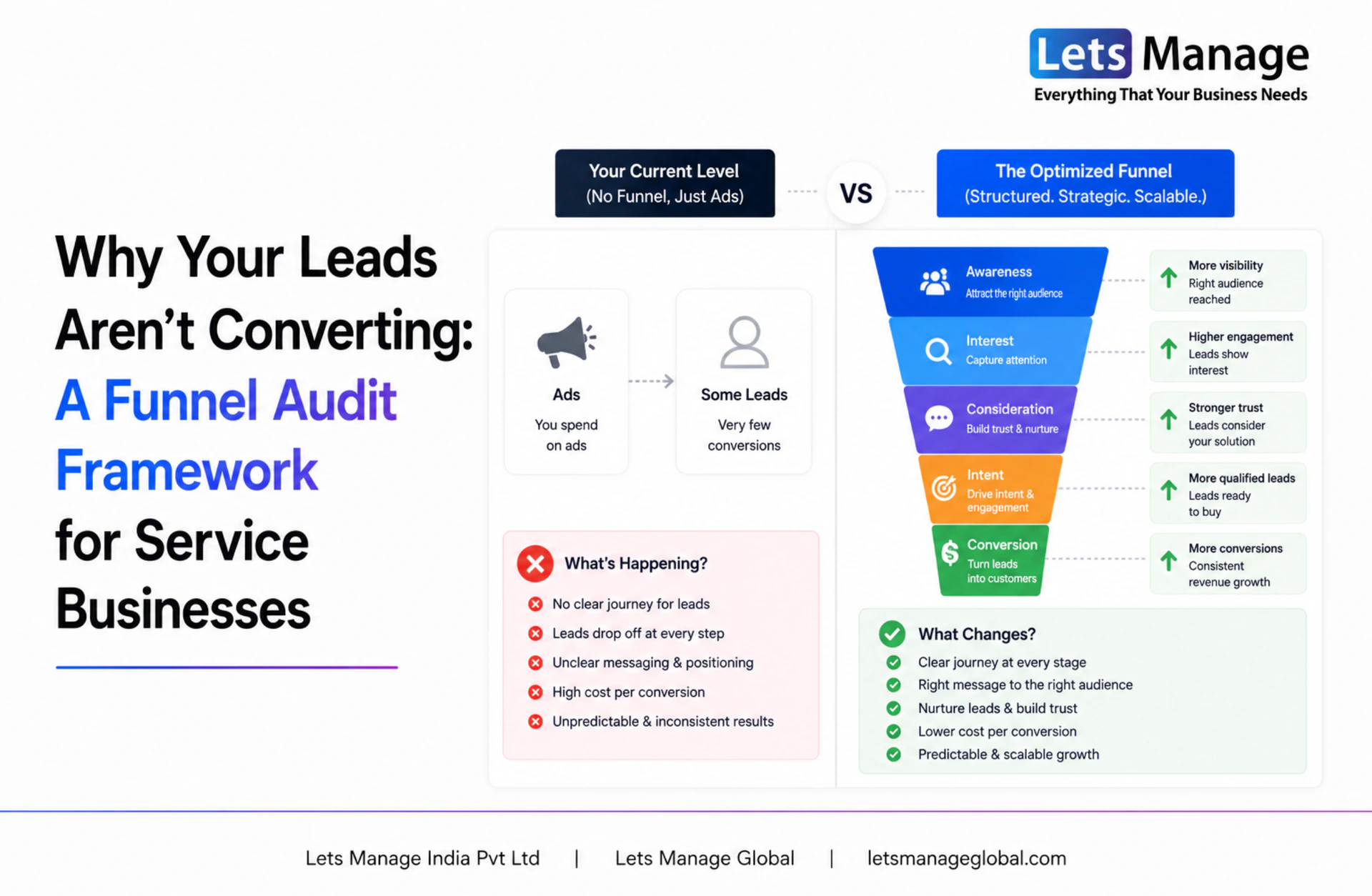
Quick answer: When leads arrive but do not convert, the problem is almost always in one of four places: unclear or mismatched ad targeting, a landing page that does not match the ad's promise, slow or inconsistent follow up, and a sales process that does not address the specific objection that stage of customer has. The fastest way to find the leak is to audit the funnel stage by stage, not to simply "add more leads."
The four stage funnel audit
1. Ad and audience match: Is the ad genuinely reaching people who fit the actual customer profile, or is volume being generated from a broad, low intent audience that was never going to convert?
2. Landing page match: Does the landing page immediately confirm the exact promise made in the ad, in the same language, or does it force the visitor to re-orient themselves and lose momentum?
3. Speed and quality of follow up: Leads contacted within the first few minutes convert at dramatically higher rates than leads contacted hours later; a slow or inconsistent follow up process quietly destroys otherwise good leads.
4. Objection handling in the sales conversation: Are the sales team's talking points actually addressing the specific hesitation this type of lead has, or delivering a generic pitch regardless of what the prospect actually asked or hesitated about?
The most commonly missed leak: the gap between ad and landing page
Many funnel audits reveal that leads are perfectly qualified but drop off because the landing page they land on does not match the specific offer in the ad, creating a moment of doubt ("is this the right place?") that measurably reduces conversion, even when the underlying product is a good fit.
Why "just get more leads" often makes the problem worse
Adding more top of funnel volume without fixing a conversion leak simply means paying more to lose more leads at the same broken stage, which is why a funnel audit should always come before scaling ad spend, not after.
A practical audit checklist
- Pull the last 30 days of leads and categorize by outcome (converted, still in progress, lost) and reason for loss where known
- Time stamp lead arrival versus first contact to check follow up speed
- Compare ad copy and landing page headline side by side for message match
- Listen to or review actual sales conversations against common objections raised by lost leads
FAQ
How often should a funnel audit be done?
A full audit is worth doing whenever conversion rate drops noticeably, and a lighter version is worth reviewing monthly as part of normal campaign management.
Is a CRM necessary to run a proper funnel audit?
It is extremely helpful, since a CRM provides the timestamped, categorized lead data an audit depends on; without one, this data often needs to be manually reconstructed from call logs and messages.
What is a realistic lead to client conversion rate for a service business?
This varies by industry and ticket size, but for most local and professional services, a properly managed funnel typically converts somewhere between 15 and 35 percent of qualified leads into paying clients.