

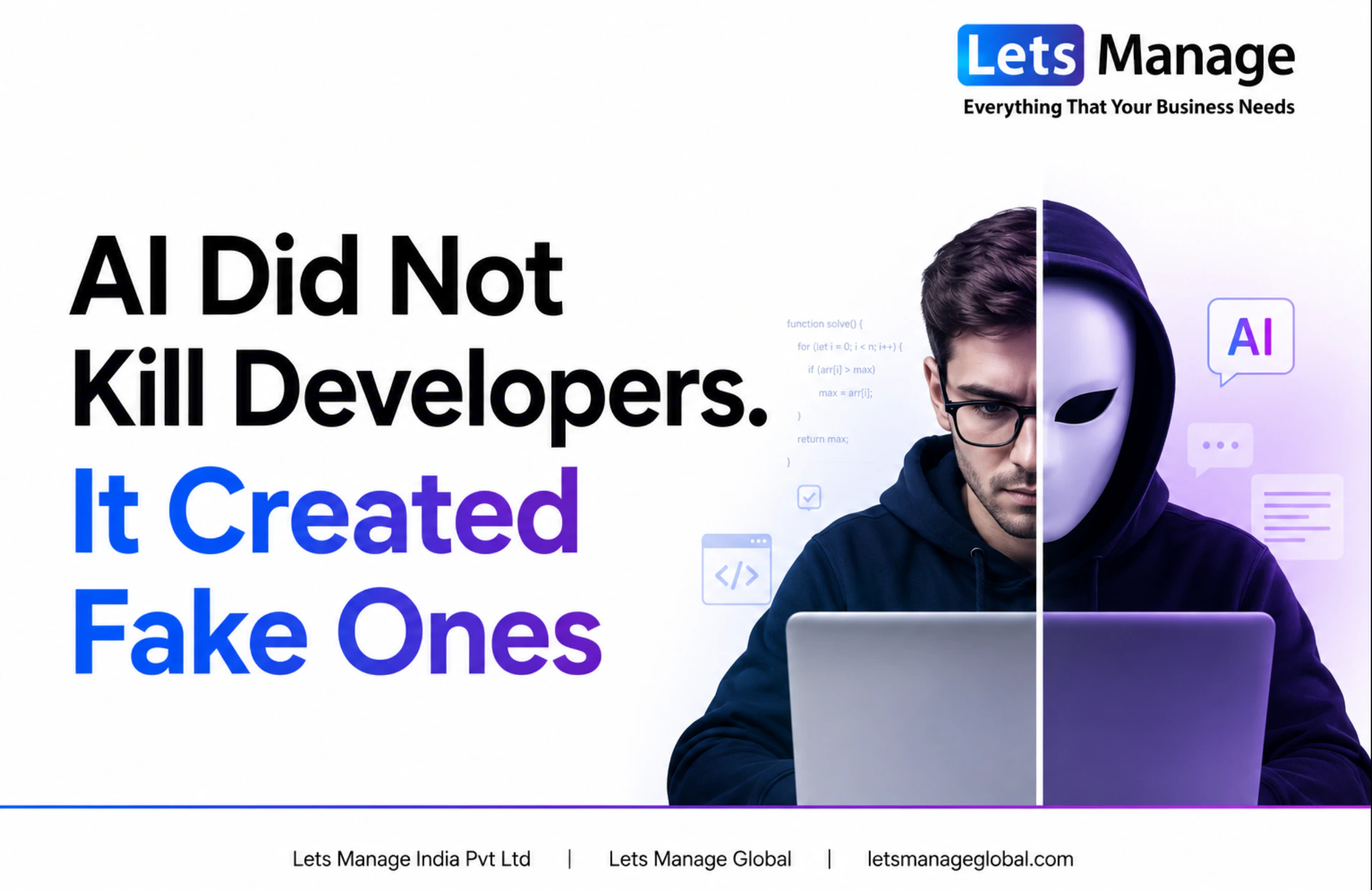
AI Did Not Kill Developers. It Created Something Worse: Fake Developers.
The rise of vibe coding has flooded the market with people who can generate code but cannot understand it. Here is why that matters far more than most businesses realise.
The threat to software development was never that AI would replace engineers. It was that AI would make everyone think they already were one.
There is a scene that plays out dozens of times every day in freelance marketplaces, LinkedIn DMs, and startup Slack channels. Someone with zero background in software development posts a portfolio of polished-looking web applications. They quote an aggressively low price. They promise fast delivery. And the business owner, who has no way to evaluate the quality of what they are buying, says yes.
Six weeks later, the product is live. It looks exactly like the demo. Then real users arrive. The database starts choking under actual traffic. An API integration fails silently and nobody knows why. A security researcher finds a critical vulnerability that was baked into the auto-generated code from day one. The person who built it has already moved on to the next client.
This is not a hypothetical scenario. It is happening at scale, right now, across every industry that has bought into the promise of cheap AI-built software. And the architects of this problem are not the AI tools themselves. They are the people using those tools without the foundational knowledge to understand what they are actually producing.
What Vibe Coding Actually Is
The term started as something between a joke and a badge of honour in certain corners of the developer internet. The premise was straightforward: instead of writing code from first principles, you describe what you want in plain language, let an AI model generate the implementation, and iterate until it looks right. No architecture planning. No deep technical understanding required. Just prompts, previews, and deployment.
For experienced developers, vibe coding is a legitimate productivity technique. When you already understand what good architecture looks like, using AI to scaffold boilerplate, generate tests, or explore implementation options faster is a genuine multiplier. The judgment is already there. The AI just removes friction.
But something shifted when the tools became accessible enough that people with no engineering background started using them to build and sell products commercially. The act of generating working-looking code got decoupled entirely from the understanding of what that code was doing, how it would behave under load, or what would happen when something went wrong.
“ Generating code and understanding code are not the same skill. Confusing the two is exactly how you end up with products that demo beautifully and collapse in production. ”
The result was a wave of people entering the software market with tools powerful enough to produce convincing outputs but without the technical grounding to evaluate whether those outputs were any good. They could ship. They could not engineer.
The Knowledge Gap Nobody Is Talking About
When you ask an experienced software engineer what their job involves, they will describe a surprisingly small amount of actual code writing. The bulk of the work is thinking: understanding constraints, anticipating failure modes, making trade-offs between competing priorities, designing systems that are comprehensible to the next person who has to maintain them.
Vibe coding skips all of that. Not because the practitioner is lazy, but because they genuinely do not know it exists. The knowledge gap is invisible to the person inside it.
Architecture and Scalability
A system that works for ten users may completely fall apart at ten thousand. The decisions that determine scalability are almost never visible in a demo. They live in how the database schema is designed, how queries are structured, how caching is implemented, how the application handles concurrent requests. An AI generating code from a prompt has no knowledge of your expected user load, your growth trajectory, or the infrastructure you are running on. It makes assumptions. Those assumptions may be completely wrong for your use case, and nobody reviewing a working demo would ever know.
Security
This is where the consequences get genuinely serious. Security vulnerabilities in software are not always obvious. SQL injection points, improperly handled authentication tokens, misconfigured API permissions, exposed environment variables, unvalidated user inputs. AI models trained on the broad corpus of public code will sometimes reproduce insecure patterns because insecure patterns exist in that training data. A developer without a security background does not know to look for these. They see code that functions. They ship it.
The liability that creates for the business that purchased the product is not theoretical. Data breaches, compromised customer accounts, regulatory violations under GDPR or similar frameworks. A cheap AI-built product can carry expensive legal consequences that nobody disclosed when the price was agreed.
Performance and Cost Structures
AI-generated code is frequently inefficient in ways that do not matter at small scale and become catastrophic at larger scale. Redundant database calls, missing indexes, N+1 query problems, unoptimised asset delivery. The application works fine during testing with synthetic data. Then the first month of real usage arrives and the cloud infrastructure bill is three times what anyone budgeted for. The person who built it is not around to fix it because the engagement ended at delivery.
Maintainability
Real software products are not static. They need to be updated, extended, debugged, and adapted as requirements change. Code that nobody fully understands is code that cannot be reliably maintained. Vibe-coded products frequently arrive as dense, poorly commented, inconsistently structured codebases that even competent engineers struggle to work with. The original builder cannot explain their own decisions because the decisions were not theirs: they were the model's. This creates enormous hidden costs for businesses that eventually need to evolve their product beyond what the initial build delivered.
Why Businesses Keep Buying It Anyway
The demand side of this problem is just as worth examining as the supply side. Businesses are not buying fake development out of ignorance alone. They are buying it because the incentives push them toward it.
Software development has always been expensive relative to what most small and medium businesses can easily budget. A $150 website from someone using AI tools versus a $3,000 engagement with a professional agency is not a difficult financial decision when you are a small business owner with limited runway. The price difference is real and the quality difference is invisible until it is not.
There is also a credibility problem in how AI-generated products present themselves. The outputs of modern AI coding tools are visually polished. They look like real software because they largely are real software, in the narrow sense that the code executes and the interface renders. The problems are structural, not cosmetic. And most buyers lack the technical vocabulary to ask the right questions before they commit.
A product that looks finished in a demo can be completely broken as an actual business. The quality of software is almost entirely invisible to non-technical buyers until something fails in front of their customers.
This is what makes the fake developer problem genuinely harmful at a market level. It is not just individual businesses getting burned on bad projects. It is the erosion of trust in software as a professional discipline, and the systematic underpricing of real engineering work that makes it harder for legitimate developers to compete honestly on price.
What Real Engineers Actually Do With AI
The irony here is sharp. The developers most loudly dismissing the fake developer problem are also, in many cases, the heaviest users of the same AI tools that enabled it. The difference is context and competence, not tool choice.
A senior engineer using Claude or Cursor to write a complex database migration script is doing something categorically different from a vibe coder using the same tool to generate a full-stack application they cannot read. The engineer knows what correct output looks like. They can spot when the model has made a subtle error. They understand the domain well enough to verify the result before trusting it in production.
Real engineering with AI looks something like this:
? Using AI to accelerate the implementation of decisions that the engineer has already made on architectural grounds
? Reviewing AI-generated code critically for correctness, security, and performance before it ships
? Understanding the trade-offs in every significant piece of generated code and being able to explain them
? Knowing when the model's suggestion is wrong and why, even when it looks superficially plausible
? Maintaining ownership of the system design independent of what any tool generates
The AI is a tool. Experienced engineers use tools. What distinguishes them is not whether they use AI but whether they bring genuine technical judgment to everything that tool produces.
“ AI can generate experience at the level of syntax. It cannot generate the years of production incidents, architectural mistakes, and hard-learned lessons that make an engineer genuinely good at their work. ”
The Real Cost of Cheap AI Products
The damage from the fake developer economy does not always show up immediately, and that delay is part of what makes it so insidious. Businesses feel like they got a great deal right up until the moment they do not.
Consider what a poorly built product actually costs over its lifetime. There is the direct cost of fixing the original problems, which typically runs higher than what the product cost to build in the first place because untangling someone else's unstructured codebase is slow, frustrating work. There is the opportunity cost of the months spent managing a broken product instead of growing the business around a working one. There is the reputational cost of performance failures and security incidents that customers experienced before anyone realised the product had fundamental issues.
Then there is the trust cost. Customers who encounter a slow, broken, or insecure product do not usually give the business a second chance. They leave, and increasingly they tell people. For a small business, a visible product failure can be far more damaging than the project ever cost to build.
None of these costs appear in the original invoice. The $100 website does not mention any of this.
How to Evaluate a Developer in the Age of AI
Businesses that want to protect themselves from the fake developer problem need to ask better questions. The presence of a portfolio no longer tells you much, because AI can generate impressive-looking portfolio pieces quickly. What matters is whether the person behind the portfolio can explain what they built and why.
Some questions worth asking before engaging any developer for serious work:
• How does your architecture handle traffic spikes? If they cannot describe a concrete approach, that is a red flag.
• What are the main security considerations in this type of application? Vague or generic answers suggest surface-level understanding.
• What would you do differently if this product needed to scale to ten times the initial user base? This question reveals whether they thought about growth at all.
• Can you walk me through a specific technical decision you made and why? Real engineers have opinions and reasoning. Vibe coders often cannot articulate either.
• What does the maintenance and update process look like after delivery? A developer who has no answer here is one who will not be available when things go wrong.
These questions are not designed to be adversarial. They are the same questions a technically informed client would naturally ask. The fact that many businesses have not been asking them is precisely why the fake developer market has grown as large as it has.
Where the Industry Goes From Here
The market is already beginning to self-correct, slowly and unevenly. Businesses that got burned on cheap AI-built products are becoming more cautious buyers. Developers who built reputations on fast, cheap AI delivery are finding that reputation increasingly difficult to sustain as clients start comparing notes.
There is also a structural economic pressure building. As AI companies move toward metered pricing and premium models get pushed behind higher-cost tiers, the margin that made vibe coding financially attractive starts to compress. The entire cheap AI website economy was built on near-unlimited access to powerful models at flat monthly rates. That era is not going to last indefinitely.
What is unlikely to change is the role of AI as a tool in serious software development. The productivity gains are real and they are already baked into how professional teams work. What will change is the expectation that those gains are available to anyone regardless of their underlying technical competence. The tools will remain. The free lunch will not.
Real developers are not worried about this shift. They were never competing primarily on speed or price. They were competing on judgment, reliability, and the ability to build things that work correctly when stakes are real. AI amplifies those qualities in people who already have them. It cannot create those qualities in people who do not.
The Uncomfortable Truth
AI did not lower the bar for software development. It made the bar invisible. And invisible bars are the ones that hurt the most when you walk into them.
The fake developer problem is not going to be solved by better AI tools, stricter platform policies, or more aggressive industry credentialing. It will be solved the same way every market credibility crisis gets solved: through enough visible failures that buyers start asking harder questions, and through enough professional developers demonstrating the gap between what they deliver and what a vibe coder delivers that the difference becomes impossible to ignore.
If you are a business owner considering a software project, understand what you are actually buying. Code is not the product. The engineering judgment behind it is. A system that functions in a demo and a system that will serve your business reliably for the next three years are not the same thing, and the price difference between them is not a negotiating point. It is a reflection of something real.
If you are a real developer watching this play out, the message is less about concern and more about positioning. The market is in the process of learning, expensively, what you already know. That lesson creates an opportunity for anyone who can clearly articulate the difference between code generation and engineering.
“ AI generates syntax. Experience generates the judgment that knows what to do with it. ”
The developers who understand the tools and the craft are not threatened by this moment. They are, in a very real sense, waiting for it.
Have you encountered fake developers in the wild? Or are you a developer navigating the AI tool landscape professionally? Share your experience in the comments.