

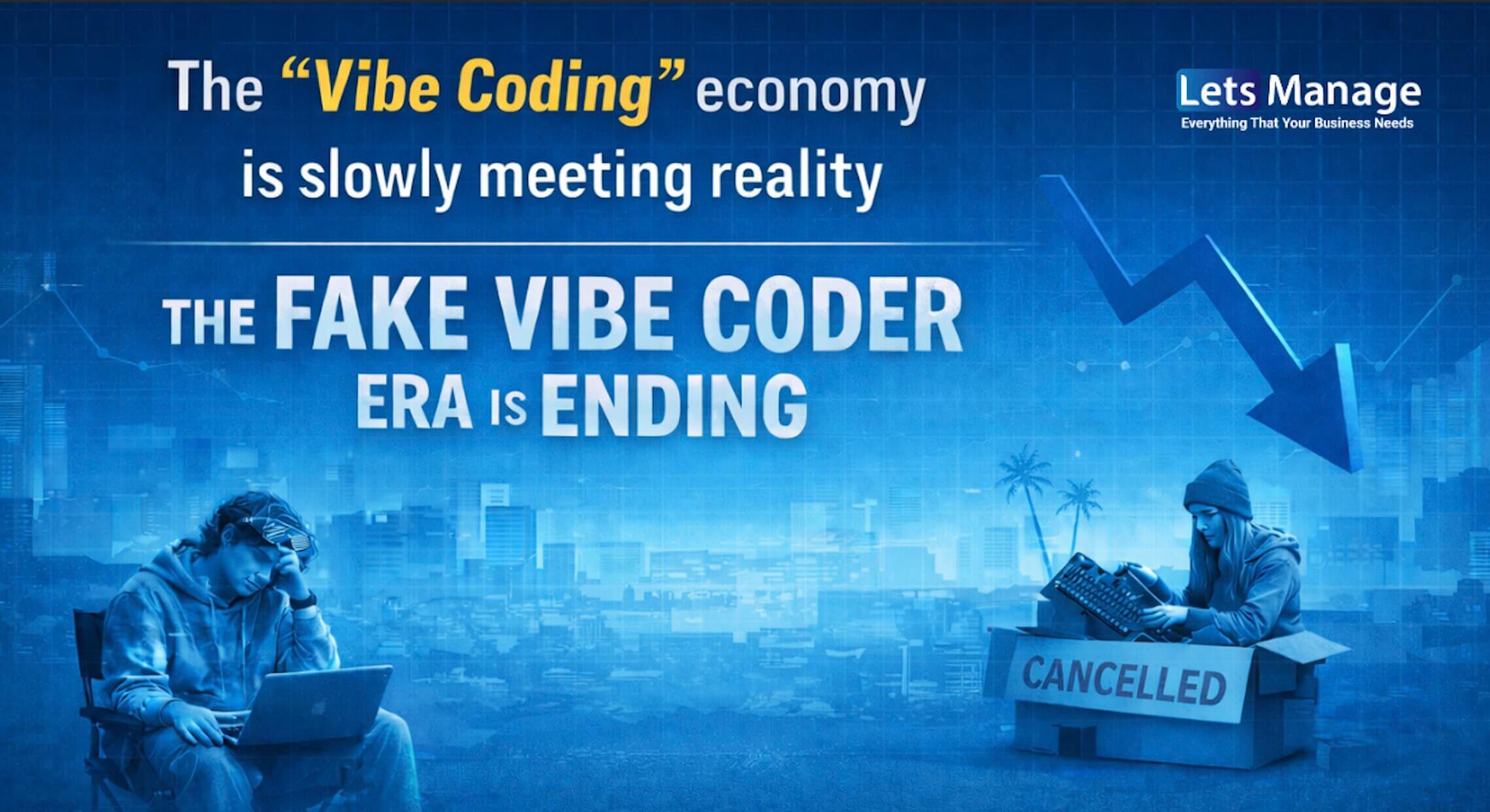
The AI bill just arrived. And it's not cheap.
For the better part of 18 months, a very specific kind of content dominated every tech corner of the internet:
"I built a full SaaS in 45 minutes with one prompt."
"Developers are DONE. AI does it all now."
"$10,000 MRR. Zero code written. Just vibes."
It was intoxicating. It was aspirational. It was - let's be honest - mostly nonsense dressed up in Loom videos and Twitter threads. But it worked. Thousands of people dove headfirst into what became known as 'vibe coding': the art of prompting AI into building products and then selling those products to businesses who didn't know the difference between a real software product and a Frankenstein of auto-generated code held together with good vibes and a Stripe integration.
But 2026 is proving to be a reckoning year. Not with a bang - but with something far more devastating to the vibe coding economy: a pricing page update.
What Is Vibe Coding - And Why Did It Explode?
The term 'vibe coding' was coined partly in jest but quickly became a genuine movement. The formula was elegantly simple:
• Open Claude, ChatGPT, Gemini, or Cursor
• Describe your 'startup idea' in plain English
• Let the AI generate a full-stack application
• Deploy it on Vercel or Railway
• Charge $200 on Upwork or Fiverr
• Repeat
At its peak, Reddit forums, LinkedIn feeds, and YouTube channels were flooded with case studies of people quitting their jobs, claiming five-figure months, and declaring that traditional software engineering was dead. Coding bootcamps started marketing 'AI-first' curricula. Business coaches pivoted to teaching 'AI agency' models. The gold rush was on.
And honestly? For a window of time, it kind of worked. AI models were extraordinarily capable, shockingly cheap to access, and crucially available to almost everyone at near-unlimited usage on basic plans. The economics were too good to be true.
Which, of course, is exactly what they were. ?
The Infrastructure Bill Nobody Talked About
Here is the thing about running a large language model: it is extraordinarily expensive. Not 'expensive for a startup' expensive. Genuinely, staggeringly expensive at scale.
Every time you send a prompt to Claude Opus, GPT-4o, or Gemini 1.5 Pro, you are consuming:
• Compute cycles on multi-million-dollar GPU clusters
• Massive amounts of electricity - a single large inference request can consume as much energy as running a search query hundreds of times
• Cooling infrastructure, data center overhead, and engineering teams running 24/7 to keep the system alive
AI companies - Anthropic, OpenAI, Google DeepMind - were never in the business of running charity compute infrastructure. They were subsidising early adoption to grow user bases, capture market share, and train better models on real-world usage data. The cheap, near-unlimited AI access of 2023 and 2024 was, in economic terms, a prolonged customer acquisition campaign.
The bill was always going to arrive. The only question was when and how steep it would be.
What Is Actually Changing in 2026
The shift is not sudden - it is deliberate, incremental, and strategically quiet. But the pattern is unmistakable across every major AI platform:
1. Premium Models Are Moving Behind Higher Tiers
The models that vibe coders relied on most heavily - the ones with deep reasoning, strong code generation, and reliable output quality - are being progressively moved out of basic and mid-tier plans. We are talking about models like:
• Claude Opus and Claude Sonnet (Anthropic)
• GPT-4o and o-series reasoning models (OpenAI)
• Gemini 1.5 and 2.0 Pro (Google)
Access to these on entry-level or student plans is either being capped heavily or removed entirely in favour of smaller, faster, cheaper base models. The performance gap between a base model and a premium reasoning model is not trivial - for complex software generation tasks, it can mean the difference between working code and plausible-looking garbage.
2. Request Quotas Are Getting Real
Even premium plans - the ones that cost $20 to $100+ per month - are no longer offering anything close to unlimited usage. Prompt quotas, request caps, and rate limits are now standard across the board. Heavy users, the type of person running twenty coding sessions a day to churn out client websites, are hitting their limits faster than they expected.
The complaints are already surfacing loudly across developer communities, Reddit threads, and Discord servers:
• 'Hit my monthly limit by week two.'
• 'Upgraded to the highest plan and still getting throttled.'
• 'The model I was using disappeared from my plan overnight.'
These are not isolated incidents - they are the early symptoms of an industry-wide repricing of AI access.
3. Consumption-Based Pricing Is the Future
The long-term direction every major AI provider is moving toward is metered, consumption-based pricing - the same model that made AWS and cloud computing sustainable at scale. You use more, you pay more. This makes perfect business sense for AI companies. It is, however, terrible news for anyone whose business model depended on treating AI inference as a fixed-cost tool.
If you were selling $150 websites to small businesses and your entire toolchain was running on a $20/month Claude subscription, the math was always fragile. Once you start paying per token at scale, margins compress fast.
The Real Economics of the 'AI Agency' Model
Let's look at this honestly, because the numbers matter.
A typical vibe coder in 2024 might have been operating something like this:
• $20/month: Claude Pro or ChatGPT Plus
• $10/month: Cursor or Copilot for code editing
• $5–15/month: Hosting on Vercel or Railway
• $0: Figma free tier for mockups
• Total overhead: roughly $35–50/month
Against that cost, charging $100–$300 per small business website felt like incredible margins. And to be fair, if you were doing two or three projects a month with light AI usage, it probably was.
The problem is that the model breaks in both directions as it scales. More clients mean more tokens, more compute, more hitting rate limits. And as AI companies raise prices and add caps, that $35/month overhead starts climbing toward $100, $200, or more - while the race-to-the-bottom pricing in the freelance AI website market keeps pushing client rates down.
You cannot build a sustainable business on subsidised infrastructure. The subsidy always ends. ?
What Developers Always Knew
Here is the part of this story that every actual software engineer has been quietly watching with a complicated mix of vindication and exhaustion.
Software development was never - not for a single day - primarily about writing code. The code was always the easy part. The genuinely hard, genuinely skilled, genuinely irreplaceable parts of engineering were always:
• Understanding what the user actually needs versus what they think they want
• Designing systems that can survive real traffic, real edge cases, and real failure modes
• Making architectural decisions whose consequences play out over years
• Debugging production issues at 2am when everything looks fine in the logs
• Translating ambiguous business requirements into precise technical specifications
• Knowing which shortcuts are acceptable technical debt and which ones are ticking time bombs
AI can generate syntax. It can scaffold a CRUD application. It can write boilerplate faster than any human. But it cannot replace the judgment that comes from building and maintaining real systems over real time. It cannot replace the engineer who has been burned by a particular architectural pattern and knows, in their gut, why it will fail again.
The vibe coding narrative was predicated on a fundamental misunderstanding of what engineering actually is. It confused the visible output - lines of code - with the invisible labour - decades of pattern recognition, hard-won intuition, and systematic thinking about complex systems.
Engineers were never just 'people who type code.' They were, and remain, people who think about systems. AI is an extraordinarily powerful tool for the thinking. It is not a replacement for the thinker.
Is This Just a Correction, or the End of Cheap AI?
The nuanced answer, which is also the correct one, is: both, and neither is catastrophic.
What we are seeing is not the death of AI-assisted development - AI coding tools are genuinely, demonstrably useful and are becoming a permanent fixture in every professional software team's workflow. What is dying is the fantasy that AI would remain a cheap, unlimited, infinitely scalable commodity forever.
The correction we are seeing in 2026 has a few likely outcomes:
The Amateur End Gets Squeezed Out
The lowest-margin vibe coders - people churning out $100 websites with zero technical depth — will find their margins crushed by rising AI costs. This is probably a healthy correction. Those products were often low quality, and the market was always going to commoditise them eventually.
The Middle Market Professionalises
Developers who used AI as a genuine productivity multiplier - writing 10x faster, exploring solution spaces more efficiently, automating tedious boilerplate - will adapt. They will absorb higher AI costs into professional rates that reflect real value. They will also be increasingly distinguished from pure vibe coders by clients who have been burned once.
AI Becomes Serious Infrastructure
At the enterprise and serious startup level, AI coding tools will become standard infrastructure line items - budgeted, managed, and evaluated like any other toolchain investment. This is healthy. It means AI gets taken seriously as a real cost of building real things, not treated as a magic free lunch.
What This Means For You
Whether you are a developer, a tech entrepreneur, or a business considering hiring AI-built products, the message is the same:
The 'unlimited AI at $20/month' era is over. AI access is becoming tiered, metered, and properly priced for the value it delivers. That is not a bad thing - it is just real.
If you are a developer, this is genuinely good news. The floodgates of $100 AI-generated websites were never a real threat to your livelihood - they were a temporary arbitrage that was always going to close. What remains valuable, and what AI cannot replicate, is engineering judgment.
If you were riding the vibe coding wave, now is a good time to ask an honest question: are you adding genuine value, or were you just arbitraging cheap AI access? The answer will determine whether the next two years are a growth story or a hard reset.
And if you are a business that bought a $150 AI-generated website in 2024 - well. You might want to get that looked at.
The Bottom Line
The vibe coding bubble is not popping. It is being repriced. And repricing always reveals what was actually valuable.
AI is not going away. It is not even getting worse. It is getting more expensive — which, counterintuitively, is a sign that it is getting more serious. When something moves from 'free toy' to 'priced infrastructure', it means someone has decided it is valuable enough to charge for properly.
The developers who survive and thrive in this era will be the ones who understood from the beginning that AI was a tool — an extraordinary, transformative, genuinely historic tool — but still just a tool. And tools are only as valuable as the skill of the hands holding them.
The engineers were never finished. They were just waiting for the bill to arrive. ?
What do you think? Is the vibe coding correction overdue - or are we overstating how much AI access is actually changing? Drop your thoughts in the comments.