The Business
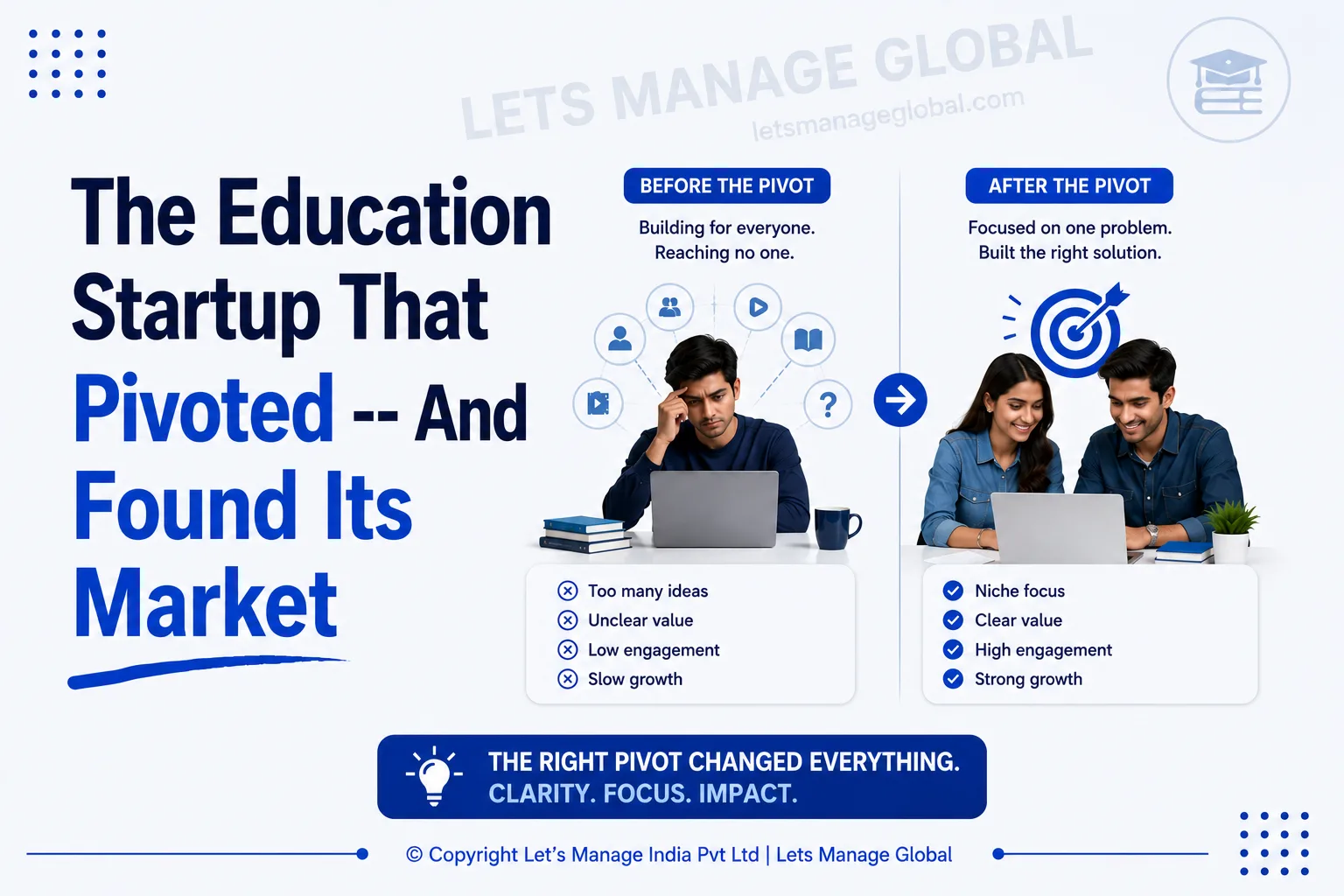
Kavita launched an edtech business offering professional skills training for fresh graduates and early-career professionals. She had strong content, experienced facilitators, and a clear vision of the problem she was solving. After 18 months, revenue was Rs 22 lakh against a Rs 2 crore annual target. Something fundamental was not working.
The Problem
Kavita had built an excellent product for a market that was structurally difficult to monetise at her scale.
→ Fresh graduates had very limited disposable income for self-investment in training
→ The willingness to pay for learning was high in aspiration but low in actual conversion
→ Sales cycles were long and conversion rates were below 3% on marketing spend
→ Course completion rates were under 40% -- reducing testimonial generation and word-of-mouth referral
→ The competition in the D2C online learning space was intense and well-capitalised
The Diagnosis
The diagnosis was direct: the product was right but it was being sold to the wrong buyer through the wrong channel.
→ B2C fresh graduate segment: high acquisition cost, low willingness to pay, low completion rates, high competition
→ B2B corporate training segment (tested through 12 exploratory conversations): high willingness to pay, bulk purchasing, clear ROI narrative, existing budget line
→ Government and university partnership segment: slow decision cycles but large volume and institutional stability
The Solution
Phase 1: B2B Validation (Month 1-4)
Rather than a full pivot immediately, a four-month validation phase tested the B2B hypothesis with minimal investment:
→ Ten companies approached with a pilot offer: a customised 2-day training programme for their early-career team, priced at Rs 1.5 lakh for up to 20 participants
→ Four pilots secured in 6 weeks -- validating both willingness to pay and the relevance of the content
→ Average pilot NPS: 74 -- companies asked about follow-on programmes
→ Average per-participant revenue: Rs 7,500 versus Rs 8,000 B2C -- but with near-zero acquisition cost and 100% completion rate
Phase 2: Model Build and Scale (Month 4-12)
→ B2C subscription business wound down over six months -- existing subscribers served through completion
→ B2B product suite developed: foundational programmes (2-day), intermediate programmes (5-day), and ongoing learning cohorts (3-month)
→ Pricing architecture built for corporate buyers: per-participant, per-cohort, and annual retainer options
→ A sales function built for the first time: a dedicated business development person hired
→ First anchor corporate client signed: a mid-size IT services firm for quarterly training across four batches annually -- Rs 18 lakh ARR
Phase 3: Partnership Development (Month 12-22)
→ University tie-up negotiated: placement-linked programme offered to final-year students -- university bore the cost, students got training as part of placement preparation
→ Government skill development scheme application made -- one scheme approved, adding Rs 12 lakh in contract revenue
→ Three additional corporate anchor clients signed in months 14 to 20
The Results
✓ Revenue: Rs 22 lakh (year 1, B2C) to Rs 98 lakh (year 2 post-pivot, B2B dominant)
✓ Gross margin: 18% (B2C after acquisition cost) to 54% (B2B with near-zero acquisition cost)
✓ Course completion rate: 38% (B2C self-paced) to 94% (B2B instructor-led)
✓ Active corporate clients: 7 with recurring contracts
✓ University partnerships: 2 signed
✓ Government contracts: 1 active
✓ Kavita's reflection: 'I was so attached to my original vision that I nearly missed the much bigger opportunity that was right in front of me.'
Key Lessons
A great product sold to the wrong buyer through the wrong channel is not a product failure -- it is a market insight waiting to be acted on. The willingness to test, validate, and pivot before burning all the capital is what separates businesses that find their market from those that run out of runway waiting for the market to come to them.
💡 B2B is structurally easier to monetise than B2C for most service and knowledge businesses -- higher willingness to pay, existing budget lines, bulk purchasing, and much lower acquisition cost. If your B2C product is struggling, ask whether a corporate buyer would pay more, faster, and with less friction.
💡 Pivots are not failures. They are the business's response to market information. The founders who treat early customer data as evidence and act on it -- rather than as criticism to be explained away -- are the ones who find genuine product-market fit.
💡 Kavita's business did not fail because the content was wrong. It nearly failed because she was solving the right problem for the wrong buyer. The clearest path to growth was not building a better B2C funnel -- it was changing who paid for the product.