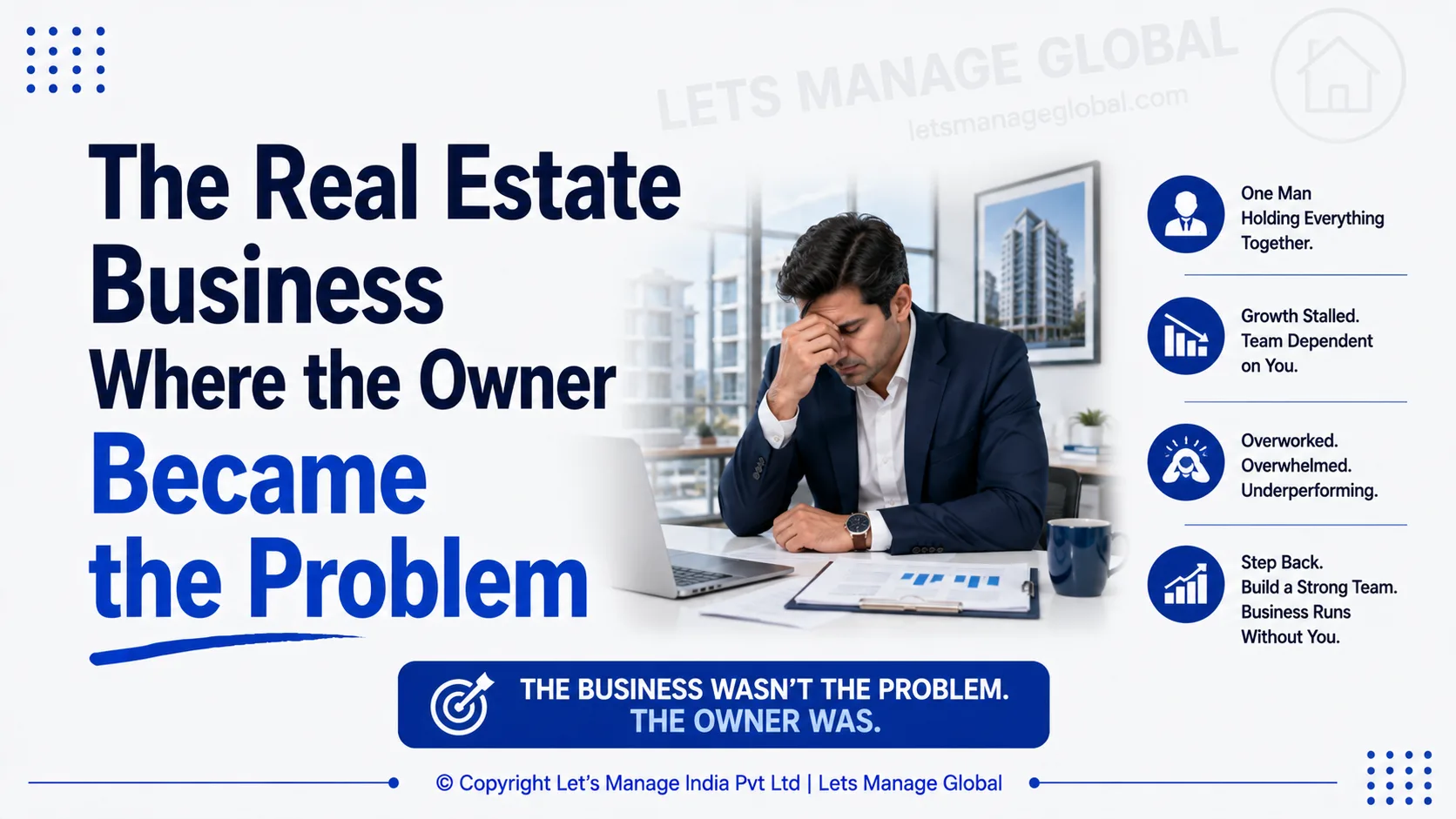
The Business
Rahul built a real estate brokerage firm over ten years from a solo practice to a team of 18 agents and support staff. Revenue was Rs 2.4 crore annually. He was well-known in his market, had strong developer relationships, and a loyal team -- or so he believed.
When a trusted advisor suggested an external business review, Rahul agreed confidently. What the review found surprised him deeply.
The Problem
Rahul's response to this feedback, once shared with him: silence for a long moment, then: 'I did not know they felt this way. I thought I was being demanding because I had high standards.'
→ Rahul regularly reversed decisions made by team managers in front of the team, undermining their authority
→ Public criticism of team performance was common -- specific individuals named in front of peers
→ When Rahul was in the office, the team operated differently than when he was absent -- in his words, 'more carefully'; in their experience, 'more fearfully'
→ New ideas were rarely raised in meetings because they were routinely dismissed without genuine consideration
→ Three high-performing agents had left in the past 18 months, all citing 'better opportunity' -- the exit interviews had not explored the real reasons
The Diagnosis
→ Rahul's leadership style had been appropriate for a five-person team but was damaging a 18-person team with managers
→ The business had grown but Rahul's management approach had not evolved with it
→ A culture of fear had replaced a culture of performance -- staff were avoiding mistakes rather than pursuing excellence
→ The three departures represented approximately Rs 65 lakh in annual revenue now serving competitors
→ No structured feedback mechanism had ever existed -- Rahul had no way to know what the team really experienced
The Solution
Phase 1: Awareness and Accountability (Month 1-3)
Rahul committed to a genuine leadership development process -- not a cosmetic one. The first three months were focused entirely on awareness:
→ Weekly coaching sessions focused on specific incidents: examining the impact of particular decisions and communication choices
→ A 'leadership journal' kept by Rahul: moments he noticed himself reverting to old patterns and what he chose instead
→ A small group of team managers given explicit permission to give Rahul direct feedback -- in monthly sessions
→ Rahul made a public commitment to the team: 'I am working on how I lead. I want you to experience the difference. And I want you to tell me when you do not.'
Phase 2: Structural Change (Month 3-8)
→ Manager authority formally defined -- decisions within their domain cannot be reversed by Rahul publicly
→ A structured team meeting format introduced: managers present their updates; Rahul asks questions rather than directs
→ An anonymous feedback channel created for all team members -- reviewed monthly by Rahul
→ Performance conversations restructured: specific, private, forward-looking rather than general and public
Phase 3: Culture Rebuilding (Month 8-16)
→ A quarterly all-team survey on culture and leadership -- results shared with the full team
→ Recognition practice formalised: specific, public acknowledgement of excellent work and behaviour
→ Two of the three departed agents were quietly approached -- one returned
→ New hiring: culture fit made an explicit, assessed criterion
The Results
✓ Team voluntary attrition: from 3 departures in 18 months to 0 in the following 16 months
✓ Revenue: Rs 2.4 crore to Rs 3.1 crore in 16 months
✓ Team engagement score (anonymous survey): 4.1 to 7.6 out of 10
✓ One of the three previously departed agents returned
✓ New ideas raised in team meetings: measurably increased -- tracked by meeting facilitator
✓ Rahul's self-assessment: 'The most difficult and most valuable thing I have ever done for my business'
Key Lessons
In a growing business, the owner's leadership style is often the last thing to be examined and the first thing causing cultural damage. Demanding high standards and creating a culture of fear are not the same thing -- but they can feel like the same thing if nobody has the safety to say so.
💡 Exit interviews that say 'better opportunity' almost always mean something else. Build the culture where people can say the real thing before they leave -- and act on it when they do.
💡 Leadership development requires real commitment, not compliance. Rahul's willingness to be genuinely vulnerable with his team, to name what he was working on, and to ask them to hold him accountable -- that was not a weakness. That was the moment the business changed.